
EU Declares Critical Citizens Outlaws (English)
Karel Beckman | Date: January 12, 2026
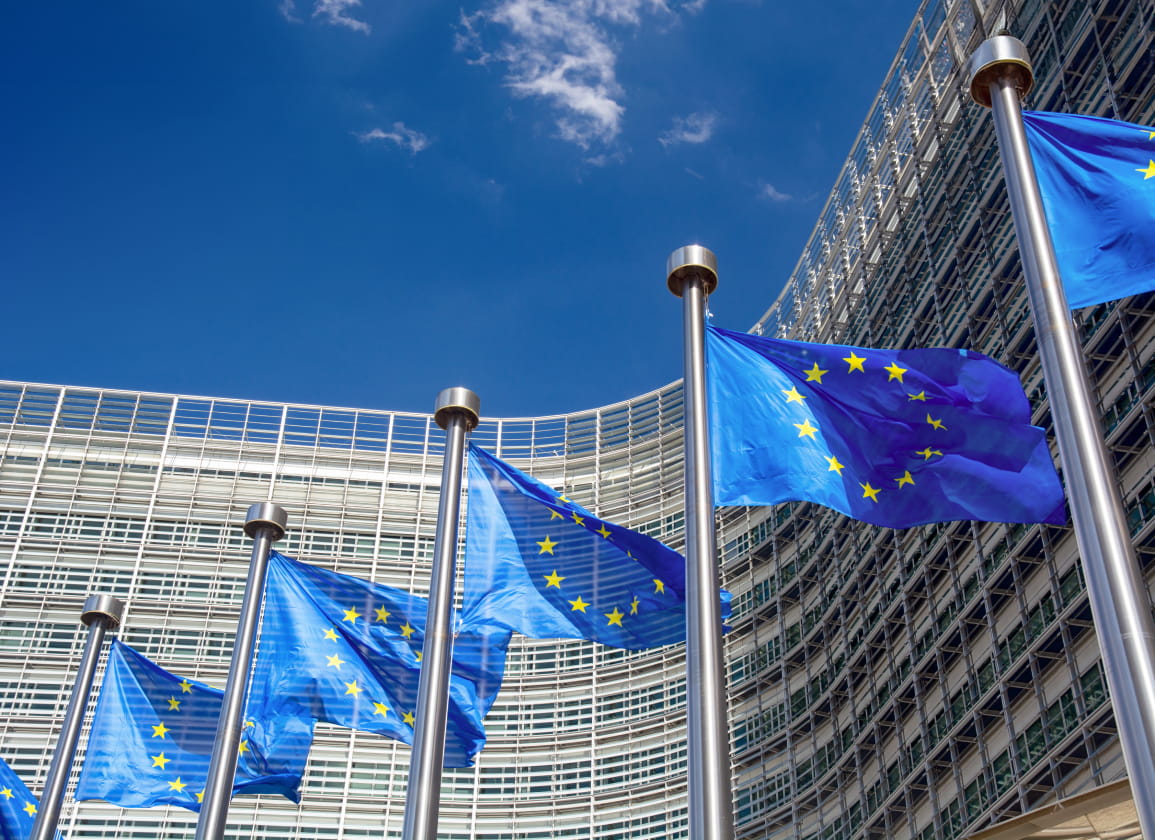
EU flags at the European Commission building | iStock
Legal experts shocked, Brussels crushes dissidents who have not violated any law
This article is updated with the latest news on January 12 and translated to English. Link to original Dutch article of January 9: https://deanderekrant.nl/eu-verklaart-critici-vogelvrij/
Some voices are being raised in defence of the outlawed citizens. In the Netherlands, FVD-Parliamentarian Gideon van Meijeren (FVD) on 12 January submitted questions to Dutch Minister of Foreign Affairs David van Weel. Among other things, Van Meijeren wants to know whether the minister can confirm that “EU residents who are not doing anything illegal can, on the basis of this decision, be subjected to far-reaching sanctions.” He also asks the minister whether he acknowledges that people can be subjected to far-reaching sanctions “purely and solely because of unwelcome opinions that are not criminal offences.” He argues that the Netherlands should strongly advocate within the European Council for an amendment to the sanctions regime, which in his view should at the very least be limited “to persons who are guilty of criminal or demonstrably violent acts.” Dr Alexandra Hofer of Utrecht University, who specialises in international law, says in an email that she is “glad that attention is being paid to this important issue in the Dutch parliament.” https://www.tweedekamer.nl/kamerstukken/kamervragen/detail?id=2026Z00230&did=2026D00605
Meanwhile, the Swiss Federal Department of Foreign Affairs (FDFA) has lodged an official protest in Brussels, arguing that the sanctions imposed on Jacques Baud have not been preceded by due process and that freedom of expression had not been respected. https://forumgeopolitica.com/article/the-jacques-baud-case-bern-lodges-a-protest-with-the-eu
With unanimous support from the member states, the EU has stripped several dozen citizens of their civil rights solely because they are critical of Ukraine policy. This was done without warning, without any form of due process, and without any factual substantiation. Those affected cannot legally defend themselves, because they have not violated any law. “It is staggering,” says German Member of the European Parliament Michael von der Schulenburg, who has investigated the matter in depth. “These people have been declared outlaws. We are going back to the Middle Ages.”
Last month, commotion arose in Switzerland and Germany when it emerged that Swiss colonel (ret.) Jacques Baud had been placed on the EU’s sanctions list. The European Council (the member states) and the European Commission accuse him of being a “mouthpiece” for “pro-Russian propaganda.” He is also alleged to have spread “conspiracy theories.” One such claim is that he supposedly said that “Ukraine orchestrated its own invasion in order to be able to join NATO.” Baud, who has previously worked for, among others, NATO and the UN and has authored many books, is known as a thorough geopolitical analyst, albeit one who is extremely critical of EU policy. He has no ties whatsoever to Russia. Nor is he accused of violating any law. He himself states that the “conspiracy theory” referred to by the European Commission originates from a Ukrainian government official whom he merely quoted.
Nevertheless, these accusations—without further substantiation or source references—were sufficient reason for the EU to place him on the sanctions list. This list is part of the sanctions against Russia. He is now the 59th person on the list, which includes not only Russians but also Germans, Swiss, French citizens, and others, such as the Swiss-Cameroonian political activist Nathalie Yamb and the German journalist and Israel critic Hüsseyin Dogru.
The consequences of this measure for Baud and the others are scarcely imaginable. Their bank accounts are frozen; they are no longer allowed to travel within the EU or through European airspace. No one is permitted to engage in economic relations with them or even provide them with financial assistance. As a result, they can no longer earn any income. “They have been completely deprived of their rights,” says von der Schulenburg in an interview with Swiss legal scholar Dr. Pascal Lottaz.
Von der Schulenburg has been concerned about the fate of the sanctioned individuals for some time. In October 2025, he published an in-depth legal opinion, written at his request by two legal scholars, Prof. Dr. Ninon Colneric and Prof. Dr. Alina Miron, in which the sanctions regime is dissected. The process underlying the sanctions measures turns out to be completely opaque. Von der Schulenburg says: “We do not know what the decision is based on, who makes it, or why certain people are selected. The entire protocol is secret. Those concerned are not warned in advance. All we see is the decision. And that decision consists of nothing more than a brief description.”
What makes the situation even more distressing is that, according to von der Schulenburg, there is nothing the affected individuals can do to challenge their case. “They have not violated any law. I have no idea what these people could do. There is also no time limit on the punitive measures, and there are no concrete actions defined that they could take in order to be removed from the list.”

Von der Schulenburg’s analysis is confirmed by legal scholar Dr. Alexandra Hofer of Utrecht University, who was also interviewed by Lottaz. “Those affected receive no information whatsoever. No accusations, no facts, nothing. This is not a legal measure but an administrative one,” Hofer states.
Those involved can turn to the European Court of Justice (ECJ), but according to Hofer this offers little relief. “What the Court does is merely fact-check whether what is stated in the decision is correct. Baud is described as being a ‘mouthpiece’ for Russian propaganda—nothing more. They do not say, for example, that he is being paid by Russia. Suppose he challenges this. What exactly is a ‘mouthpiece’? Nobody knows. The ECJ does not assess whether the sanctions decision as such is lawful or proportionate. The ECJ adopts a very deferential stance toward the European Council. It is assumed that political decisions pursue legitimate objectives.” She gives the example of two Russian oligarchs who were placed on the sanctions list and challenged this at the ECJ. “They won their case, because the description in the sanctions decision turned out to be incorrect. That description was then amended, and they were simply put back on the list.”
According to Hofer, the sanctions regime has its origins in the anti-terrorism legislation adopted after the 9/11 attacks in 2001. “Under the Treaty of Lisbon (2007), the European Council acquired the power to act preventively against the danger of terrorist attacks. In this way, they can target alleged foreign terrorists without the involvement of judicial procedures. But they are now deploying this instrument against their own citizens who are critical of EU policy.”
Lottaz, the initiator of Neutrality Studies, an organization of academics specializing in geopolitical neutrality, points out that anyone can be affected. “It can happen to all of us. All the European Council has to do is accuse someone of what is called ‘foreign information manipulation and interference.’ A single paragraph, in which literally anything can be alleged, is sufficient. We are at the mercy of the arbitrariness of anonymous officials.” He fears that the sanctions imposed so far are only the beginning. “They now have this instrument. A very convenient instrument. You can use it against anyone and anything.”
Von der Schulenburg finds it most troubling that hardly anyone is concerned about what is happening. “The mainstream media pay little attention to it. In the European Parliament I receive support from at most ten parliamentarians. The EU is destroying itself, as a constitutional state governed by the rule of law, and nobody seems to care.”
For a solid analysis of the sanctions regime, see the article by Pascal Lottaz, What Goes Around: The EU’s Extralegal Sanctions Regime. dakl.nl/eu-burgers-vogelvrij-1
Lottaz has conducted interviews with, among others, Nathalie Yamb; Dr. Alexandra Hofer of Utrecht University; and Michael von der Schulenburg. dakl.nl/eu-burgers-vogelvrij-2, dakl.nl/eu-burgers-vogelvrij-3, dakl.nl/eu-burgers-vogelvrij-4.
The report by von der Schulenburg can be found here: dakl.nl/eu-burgers-vogelvrij-5
The sanctions are published here: dakl.nl/eu-burgers-vogelvrij-6
The Swiss-Cameroonian political activist Nathalie Yamb was placed on the EU sanctions list earlier than Jacques Baud. She incurred the wrath of French President Macron when, at a conference in Sochi, Russia, in 2019, she spoke out against the French presence in Africa—to the delight of many Africans, who dubbed her “the Lady of Sochi.” The U.S. Department of State accused her of being supported by “the network of (Russian oligarch) Yevgeniy Prigozhin in Africa.”
The EU’s decision has hit her hard, she tells Lottaz in an interview. Her bank accounts were blocked. One of her accounts was even closed without her receiving her money back. She is currently in Africa, but even there she is affected by the sanctions. African airlines boycott her. Travel agency Expedia collected money for a booking she made for a flight outside the EU and then canceled the reservation without refunding the money. Even her Spotify, Netflix, and similar accounts were terminated. The Swiss authorities are doing nothing for her, she says. “My mother is turning 80. I will soon become a grandmother. But I cannot be with my mother or my grandchild in Switzerland. That is their goal: to break you mentally, to undermine your resilience and decisiveness. To ensure that you have so many financial and personal worries that you can no longer continue your struggle.”
Can citizens really be deprived of their rights so easily in the EU? Is there no possibility of invoking human rights treaties? The first problem is that a human rights court requires that someone first litigate at the national level, says Lottaz. But a national judge may not take a case because this concerns a decision of the EU.
What about the European Convention on Human Rights (ECHR)? Bizarrely enough, the EU has never ratified this Convention, Hofer confirms. It has only been ratified by the member states. She points out that the EU has not signed the ICCPR (International Covenant on Civil and Political Rights) either.
Then there is the Charter of Fundamental Rights of the European Union, which is supposed to safeguard the fundamental rights of EU citizens, but judges have often been willing, according to Hofer, to accept limitations on these rights where sanctions are concerned. She is currently investigating with fellow jurists whether there are other options, but at the same time states that “other action is needed. We must organize ourselves, inform ourselves, and appeal to the European Parliament.”
Former lawyer Frank Stadermann, who provided legal assistance to many critical doctors during the COVID period and recently published the book The Corona Inquisition, calls it “fundamentally unacceptable that someone can be punished outside national laws and without having access to a national judge who can rule on the measure or punishment. The person concerned should have the right to have their appeal to fundamental rights—rights that are being violated by the EU—reviewed by an independent judge. This is less a matter of interpreting laws than of respecting elementary principles upon which legislation is, or should be, based.”
Wat je alleen leest in De Andere Krant



Dossiers